Recently, the Department of Obstetrics at the hospital successfully managed an exceptionally complex and rare high-risk pregnancy involving three major risk factors: twin pregnancy, a history of surgery for cervical cancer, and placenta previa complicated by placenta accreta spectrum (PAS).
Under the close guidance of Professor Chen Dunjin, academic leader of the Severe Maternal Rescue Center Team from the Third Affiliated Hospital of Guangzhou Medical University, introduced to the hospital’s Department of Obstetrics through the “Three Famous Projects” program, and with meticulous coordination among our multidisciplinary obstetric team, the surgery was successfully completed. Maternal and neonatal safety was ensured, and importantly, the patient’s uterus was successfully preserved.
The successful management of this challenging case demonstrates the hospital’s Department of Obstetrics’ comprehensive capabilities in treating complex and critically ill obstetric patients and reflects the department’s continued advancement in high-risk maternal care.
A rare and highly complex high-risk pregnancy
On Jan. 26, 2026, Ms. Wu (pseudonym) was admitted to the Department of Obstetrics at Shenzhen Maternity and Child Healthcare Hospital at 35 weeks and 5 days of gestation with a twin pregnancy.
Her condition was exceptionally complex. In addition to carrying twins, she had previously undergone radical trachelectomy for cervical cancer and was diagnosed during the current pregnancy with placenta previa complicated by placenta accreta spectrum. Together, these conditions presented significant surgical challenges.
The first major challenge was the severely altered pelvic anatomy resulting from her previous cervical cancer surgery. Normal pelvic anatomy had been significantly disrupted. Dense adhesions were present between the anterior uterine wall, anterior peritoneum, and bladder, while markedly dilated and congested vessels surrounded the lower uterine segment, making surgical exposure and dissection particularly difficult.
The second major challenge was placenta previa complicated by placenta accreta spectrum. The placenta completely covered the region of the original internal cervical os. Because of the abnormal and extensive vascularity in this area following the previous surgery, placental separation carried an exceptionally high risk of severe and potentially life-threatening hemorrhage. Such cases are traditionally associated with a high risk of hysterectomy and serious maternal complications. Every step of the dissection therefore required meticulous planning and execution, as controlling hemorrhage while preserving the uterus would be critical to the outcome.
“Patients with conditions this complex may ultimately require termination of pregnancy and, in some cases, hysterectomy. However, the patient had a very strong desire to preserve her uterus,” explained Director Li Lixian. “Our challenge was to strike the right balance between oncological safety and uterine preservation. This placed exceptionally high demands on surgical expertise, multidisciplinary coordination, and emergency preparedness.”
Meticulous planning and multidisciplinary preparation
Given the complexity and potential risks of the case, Tu Xinzhi, a candidate academic leader in obstetrics and Secretary of the First Party Branch of the Department of Obstetrics, promptly activated the multidisciplinary team (MDT) mechanism for high-risk pregnancies Jan. 28.
She coordinated an online multidisciplinary consultation involving specialists from obstetrics, gynecology, anesthesiology, the General Intensive Care Unit (ICU), radiology, and transfusion medicine. Professor Chen was also invited to provide remote specialist guidance and participate in the careful evaluation of the surgical plan.
During the consultation, Tu provided a comprehensive assessment of the patient’s condition. Given the twin pregnancy, previous cervical cancer surgery, and complex pelvic anatomy, several potential intraoperative challenges might be encountered, including severe adhesions, abnormal vascular proliferation in the lower uterine segment, and displacement of the ureters from their normal anatomical positions. Comprehensive preparations for potential massive hemorrhage were therefore considered essential.
Based on the patient’s preoperative placental MRI findings, with a placental assessment score of 6, Tu determined that prophylactic placement of an abdominal aortic balloon occlusion catheter was not indicated at that stage. She also made detailed arrangements for the patient’s perioperative management.
Director Zhu Wenfeng of the Department of Gynecology then provided a specialist opinion on this case. She noted that the patient had previously undergone a radical trachelectomy and reported no abnormalities on postoperative follow-up, suggesting that her cervical adenocarcinoma was currently considered cured. As HPV testing and a ThinPrep cytologic test (TCT) had not been performed during the current pregnancy, she recommended completing these examinations before surgery. If no significant abnormalities were identified, uterine preservation could be considered intraoperatively.
She also recommended considering prophylactic ureteral stent placement to prevent ureteral injury, and emphasized the need for meticulous intraoperative technique to avoid laceration of the lower uterine segment.
After a detailed evaluation, Professor Chen advised that, provided tumor recurrence was strictly excluded, every reasonable effort could be made to preserve the uterus. He emphasized the importance of fully informing the patient and her family of the substantial surgical risks, and recommended techniques such as intraoperative cell salvage to manage potential major hemorrhage. He also provided key recommendations regarding surgical incision selection, placental management, and hemorrhage-control strategies.
Following comprehensive multidisciplinary discussion, the team established four core principles: precise assessment, adequate blood preparation, damage control, and prioritization of maternal safety.
With these principles in place, a comprehensive tiered surgical plan was developed. This included detailed preoperative MRI assessment to determine the optimal surgical approach, the combined use of conservative hemostatic techniques when appropriate, and readiness to proceed immediately to hysterectomy if bleeding became uncontrollable or maternal safety was threatened.
This extensive preparation laid a solid foundation for the successful surgery.
Advanced surgical expertise ensures a successful outcome
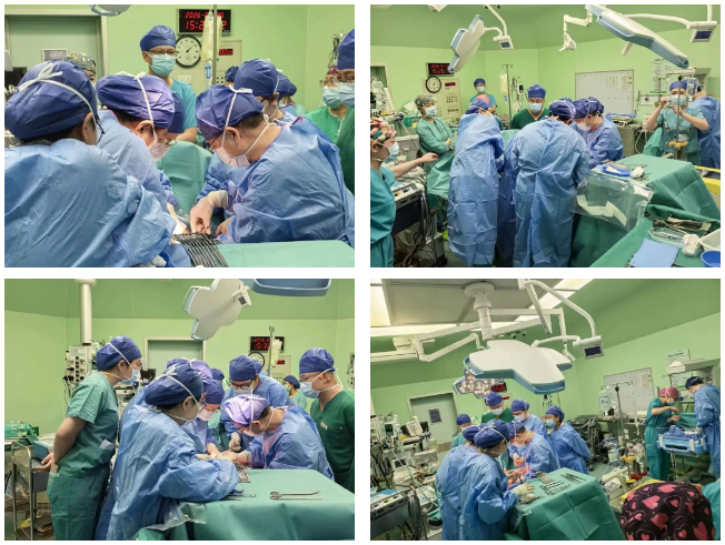
On Jan. 30, Professor Chen attended the surgery in person to provide on-site guidance. The operation was led by Director Li, with close collaboration among the obstetrics, anesthesiology, neonatology, and nursing teams.
Throughout the procedure, Professor Chen closely monitored the critical surgical steps and provided real-time guidance.
Despite the anticipated high risk of hemorrhage, meticulous surgical technique and timely, effective hemostatic measures limited the estimated intraoperative blood loss to approximately 300 mL.
The surgical team encountered multiple anatomical challenges, including adhesions between the greater omentum and abdominal wall, dense adhesions between the uterus and bladder, and altered ureteral anatomy. Through careful adhesiolysis and precise selection of the uterine incision, the team successfully delivered two babies weighing 2,515 g and 2,180 g, respectively. Both had Apgar scores of 10.
Ultimately, the operation was completed successfully. Not only was the patient’s uterus preserved, but a favorable postoperative recovery was also ensured.
The successful management of this critically ill obstetric patient reflects close multidisciplinary collaboration and patient-centered teamwork. It also demonstrates the Department of Obstetrics’ strong comprehensive management capabilities and steadily advancing disciplinary level in managing rare, complex, and critically ill obstetric conditions.
The dedicated guidance provided by experts from the “Three Famous Projects” team has also injected valuable experience and momentum into the further development of the discipline of obstetrics.
Address: No. 2004 Hongli Road, Futian District, Shenzhen (深圳市福田区红荔路2004号)
Tel:82889999 (Main switchboard)
82889999-3394 (Information desk)
83360642 (Emergency department)
Address: No. 3012 Fuqiang Road, Futian District, Shenzhen (深圳市福田区福强路3012号)
Tel:82889999-8114 (Information desk)


 search

